Shipping an AI Teaching Assistant
March 12, 2025 · AI · Research
How we turned a research prototype into an AI-powered assistant that supports student learning across multiple courses.
This time last year, I was deep in research meetings, trying to answer one deceptively simple question: how can we help students learn better with the help of AI?
The idea started as a collaborative research project at Case Western Reserve University. We weren’t just building a chatbot for professors — we were building an intelligent system that could support student learning by organizing, surfacing, and helping answer academic questions across multiple courses. Our goal wasn’t automation for its own sake — it was to create a scalable educational assistant that improved clarity, access, and engagement for every student.
What We Set Out to Solve
In every course, there are always unanswered questions — and students don’t always know where to ask them, how to find prior answers, or how to articulate them clearly. Professors, meanwhile, are overloaded. We asked:
- What if students could get help faster — with AI surfacing the most relevant content from past questions and course materials?
- What if we made question answering collaborative, transparent, and reusable?
- What if the system itself could scaffold learning, rather than just automating replies?
Our AI assistant was designed to do just that.
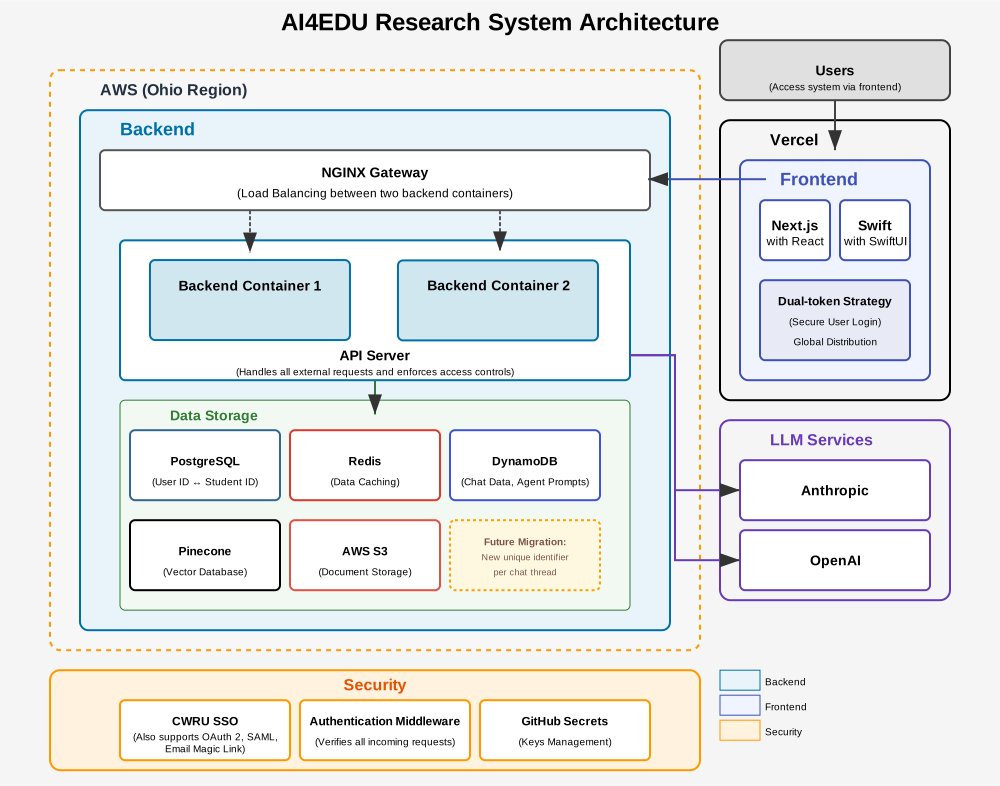
Building the Stack
We started small:
| Layer | Stack |
|---|---|
| Frontend | Next.js for the web, SwiftUI for iOS |
| Backend | FastAPI, PostgreSQL, and a Pinecone vector store |
| Auth | University SSO using JWT + role-based access control |
| LangChain | Multi-hop retrievers, summarizers, prompt pipelines |
| CI/CD | Vercel + GitHub Actions for fast iteration |
One technical breakthrough was the Retrieve Merger — a retrieval layer that pulled answers from multiple indexed sources (lecture notes, transcripts, syllabus) and re-ranked them based on student context.
We also built namespace-aware indexing in Pinecone to support multi-tenant deployments across courses and institutions.
Teaching With AI: More Than Just Answers
The assistant wasn’t meant to replace instructors — it was meant to amplify them.
- Students could ask natural language questions and receive summarized, contextual answers based on approved sources.
- The system promoted retrieval over memorization, encouraging students to learn how to ask better questions.
- Professors used it to triage and guide class discussions, surfacing common themes and confusion areas.
- The feedback loop between AI insights and instructional strategy helped educators adjust materials on the fly.
Lessons from Production
- Start simple — Our earliest version didn’t generate answers. It just organized and indexed questions. But that alone created real value.
- Students teach the system — The way students phrase questions shaped how we built retrievers and prompt logic. Their input made the system smarter.
- AI is a partner, not a proxy — Our best results came when teachers stayed involved, using the assistant to extend—not replace—their presence.
What I’m Proud Of
This wasn’t just an experiment — it became part of students’ daily academic lives. We helped make knowledge more accessible, learning more self-driven, and classrooms more responsive.
It’s still evolving, but this project taught me how AI can support real, human-centered education — not through automation, but through augmentation.
And if even one student found an answer that helped them keep going, that makes it all worth it.